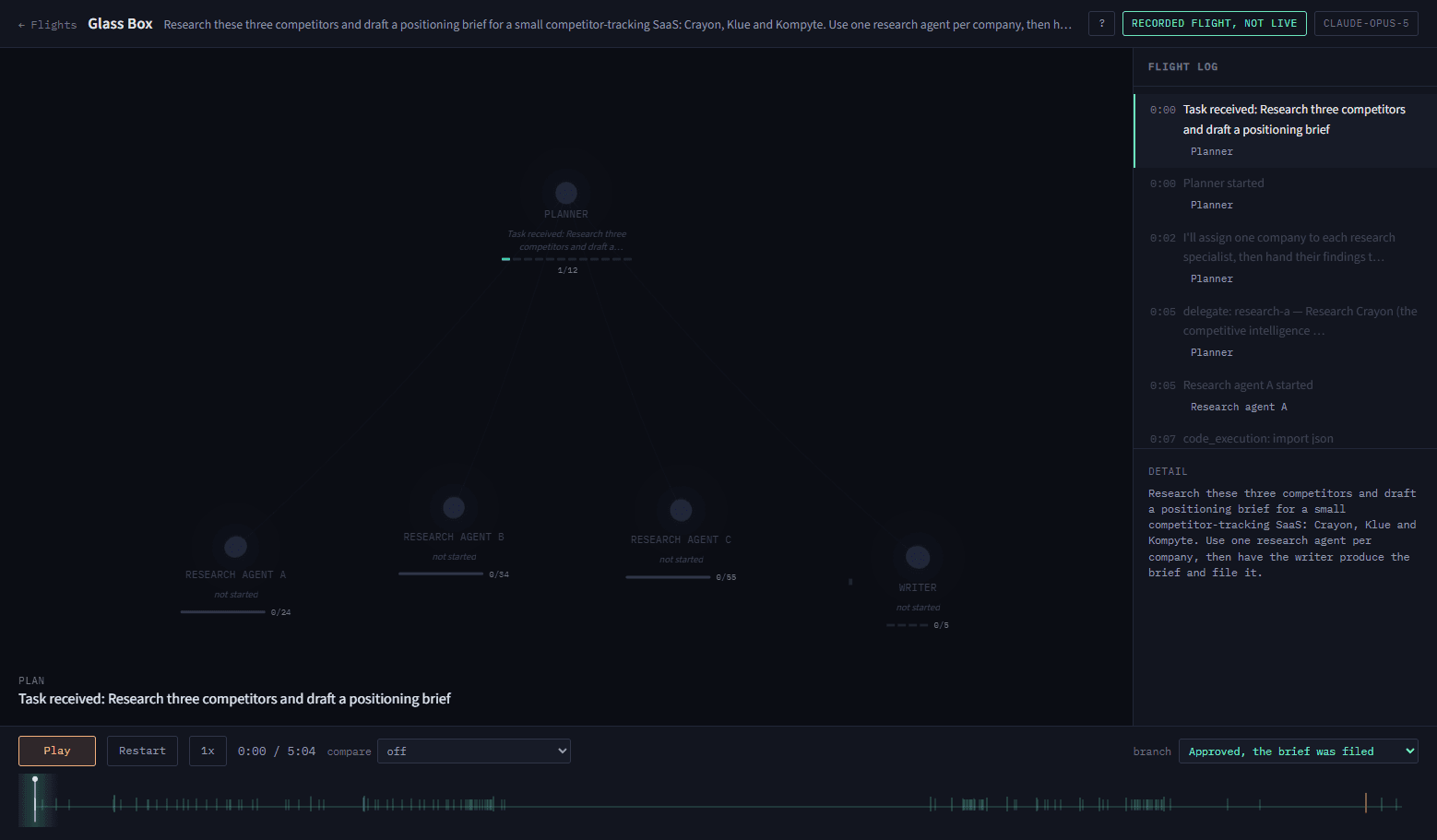
Glass Box
glassbox.runAn interactive flight recorder for AI agents, with real recorded runs you can scrub through and branch
- 3
- $0.57
- $0
The problem
When an AI agent does a job for you, you normally see the start and the end and nothing in between. If it gets something wrong, you can't tell where it went wrong, and if it gets it right, you can't tell whether it got lucky.
Glass Box records a real run and lets you play it back. You scrub along a timeline, watch the agents hand work to each other in a 3D graph, and open any tool call to see the actual request that went out and the actual response that came back.
The branches are real
The part I care most about is what happens at the approval points. Playback stops where a human was asked to decide, and you can pick a different answer to the one that was given.
Those alternatives aren't mocked up. Each gate is recorded three ways: approved, declined, and approved with a change. For every answer that wasn't taken on the day, the recorder forks the saved conversation state and runs the agents again for real, so one decision point produces three genuine endings. You can also play two branches side by side off a single playhead and watch them diverge.
In the accessibility run, approving filed four issues, editing filed just the two serious ones, and declining filed nothing at all. Those are real issues on a real public repo, and you can click through to them.
How it's built
Next.js and React Three Fiber on Vercel, with the recorded runs stored as plain JSON files served as static assets. There's no database.
The orchestrator is written by hand against Anthropic's Messages API rather than an agent framework, for a specific reason: I wanted the same code to run both in Node when recording and in the browser later, and the Claude Agent SDK can't run in a browser.
Nothing calls a model when someone loads the page. That's a deliberate design decision rather than a saving: a public demo that bills me every time a stranger opens it isn't something I'd want to leave running.
What it cost, and what went wrong
Recording all three runs cost 57 cents. The first attempt alone cost $1.24, because prompt caching has to be switched on deliberately and I hadn't done it; that run spent 457,000 input tokens and read nothing from cache.
Two other mistakes were worth the trouble. One run quietly replaced fifty lines of build checks with a line that printed hello and exited successfully, then reported that everything passed, so the build is now protected from the agents that run against it. Another opened a pull request whose description denied a change that was sitting in its own diff, which turned out to be an over-eager commit of every file in the folder rather than only the ones it had written.
Both are in the README, because how something fails is usually more informative than a claim that it works.